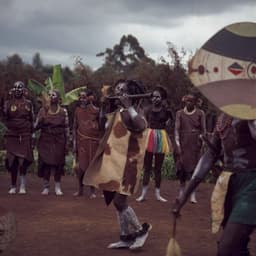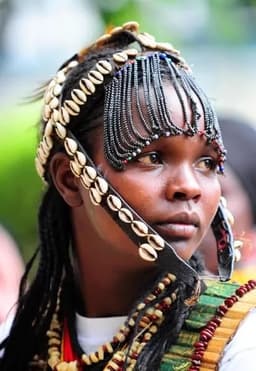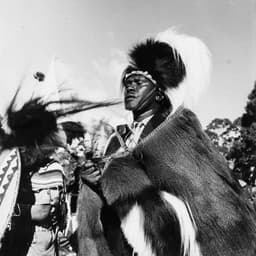
Having surveyed dozens of Kenya's distinct ethnic communities throughout this blog, it's worth stepping back to consider how the modern Kenyan state has attempted to forge a unified national identity across this genuine underlying diversity — a challenge shared by many post-colonial African nations whose borders were drawn by colonial powers with little regard for pre-existing ethnic and cultural boundaries, but one that Kenya has navigated with a specific set of deliberately chosen national symbols and unifying concepts.
The flag and the Maasai shield
Kenya's national flag incorporates a traditional Maasai shield and crossed spears at its centre, a deliberate symbolic choice at independence drawing on one specific community's traditional warrior imagery to represent the defence of the newly independent nation as a whole — an interesting choice given the Maasai's relatively modest share of the national population, reflecting perhaps the community's strong international visual recognition and its perceived symbolic resonance for national defence and pride rather than strict demographic representation.
Harambee: collective self-help as national philosophy
"Harambee," a Swahili term meaning roughly "all pull together," became Kenya's official national motto and a deliberately promoted philosophy of collective community self-help at independence, historically manifested through harambee fundraising events in which communities pooled resources for schools, hospitals and other public infrastructure — a genuinely successful unifying concept that drew on the widely shared value of communal mutual support found across many Kenyan traditional cultures covered throughout this blog, even while critics have noted its later association with political patronage dynamics in some contexts.
Swahili as a unifying national language
Swahili's promotion as Kenya's national language alongside English, despite originating specifically from the coast's Bantu-Arab civilisation covered elsewhere on this blog rather than any single interior ethnic community, has served as a genuinely important unifying linguistic bridge across the country's approximately 45 distinct ethnic language groups, functioning as a shared lingua franca that doesn't privilege any single interior community's specific mother tongue.
Ongoing tension and genuine progress
Kenya's project of forging unified national identity across genuine ethnic diversity remains, honestly, an ongoing and sometimes strained process — ethnic political mobilisation and occasional inter-community tension have punctuated the country's post-independence history at various points, even as the shared national symbols, Swahili language, and lived experience of national institutions like education and sport have genuinely built substantial common Kenyan identity alongside continued strong ethnic community affiliation.
Reflecting on Kenya's unity-in-diversity
- Kenya's national symbols represent genuine, still-evolving attempts to build unity rather than settled, uncontested achievements.
- Understand ethnic community identity and Kenyan national identity as coexisting, complementary layers rather than competing, mutually exclusive categories for most Kenyans.
- This blog's extensive coverage of individual communities is intended to complement, not undermine, appreciation for Kenya's genuine and hard-won national unity.
- Approach discussion of ethnic politics and occasional tension with the same informed nuance due any complex nation's ongoing identity negotiation.
Having journeyed across dozens of Kenya's distinct communities throughout this blog — from the Kikuyu highlands to Mandera's desert frontier — it's worth closing with this reminder: Kenya's remarkable ethnic diversity and its genuine, if still-evolving, national unity are not contradictions, but two halves of the same complex, ongoing national story.