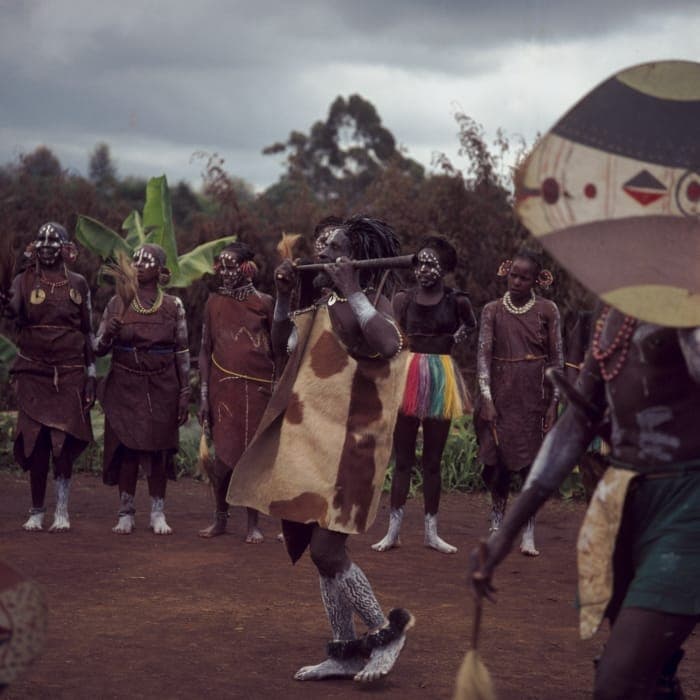
The Kikuyu (Agikuyu) are Kenya's largest single ethnic community, making up roughly one-sixth of the national population, concentrated historically across the fertile highlands surrounding Mount Kenya — Kiambu, Murang'a, Nyeri, Kirinyaga and Nyandarua counties. Their oral history traces descent from a founding couple, Gikuyu and Mumbi, said to have been given the land around Mount Kenya (Kirinyaga, "Mountain of Brightness") by the supreme deity Ngai, who was believed to reside on its snow-capped peak. That founding myth remains one of the most widely known origin stories in Kenyan popular culture, taught in schools and referenced across national political rhetoric.
Traditional Kikuyu society organised itself less around centralised chieftaincy — unlike some neighbouring kingdoms — and more around a sophisticated system of age-sets (riika) and generational cycles (ituika), through which political and ritual authority passed formally from one generation of elders to the next roughly every 25–30 years. Council of elders (kiama) structures handled dispute resolution, land allocation and ritual matters at the local level, a decentralised governance model that some historians argue made the community more resilient — if occasionally more fractious — under colonial pressure than more centralised neighbouring societies.
Land, mbari and the coffee economy
Land tenure among the Kikuyu was traditionally organised around the mbari, a patrilineal sub-clan holding rights to a defined territory first cleared and settled by a founding ancestor. This land-centred identity became politically explosive during the colonial period, when large tracts of Kikuyu land in the "White Highlands" were alienated for European settler farms, a grievance that fed directly into the Mau Mau uprising of the 1950s — a movement drawing heavily, though not exclusively, on Kikuyu fighters and oathing traditions. In the post-independence decades, Kikuyu farmers became closely associated with Kenya's coffee and tea smallholder economy, and Kikuyu entrepreneurship remains a defining feature of Nairobi's commercial life today.
Ceremony, circumcision and language
Initiation through circumcision (irua) historically marked the passage into adulthood for both young men and women, binding age-mates into a riika that would move through life stages — warriorhood, elderhood, ritual elder status — together, with mutual obligations lasting a lifetime. Female circumcision, once near-universal, has been largely abandoned or replaced with alternative rite-of-passage ceremonies following decades of public health campaigns and legal reform, though the broader age-set framework around male initiation persists in modified form in many communities today.
The Kikuyu language (Gĩkũyũ), part of the Bantu family, remains widely spoken alongside Swahili and English, and has produced a substantial body of written literature, most famously through Ngũgĩ wa Thiong'o, who controversially chose to write fiction in Gĩkũyũ rather than English as a statement on decolonising African literature.
Visiting and learning more
- The Bomas of Kenya cultural village (covered elsewhere on this blog) includes a reconstructed Kikuyu homestead alongside other communities.
- Murang'a and Nyeri counties, the historical Kikuyu heartland, retain strong traditional agricultural and market cultures worth exploring directly.
- The Karura Forest Mau Mau caves in Nairobi connect directly to Kikuyu-led independence history.
- Approach Mau Mau history with nuance — it remains a contested and still politically resonant period, not a simple, settled narrative.
As Kenya's most populous community and one deeply woven into the country's independence story, understanding Kikuyu history and social structure offers essential context for modern Kenyan politics, economy and culture more broadly.